

Decree No. 13,118/2026 sets out the structure and duties of the CIMCE, which is responsible for coordinating the next steps of the national policy.
Decree No. 13,118 of September 16, 2026, regulates Law No. 15,506/2026 with respect to the National Council for the Industrialization of Critical and Strategic Minerals (CIMCE) and establishes the Advisory Group on Critical and Strategic Minerals.
The CIMCE is the body responsible for coordinating, planning and monitoring the National Policy on Critical and Strategic Minerals (PNMCE). It reports to the Office of the President, and its purpose is to propose public policies and actions aimed at developing the production chains of critical and strategic minerals in the country.
Its duties include drawing up the National Plan for Critical and Strategic Minerals and, after consulting the National Mining Agency (ANM), accrediting, qualifying and designating priority projects, with precedence given to critical and strategic minerals essential to high-tech products and processes and to those produced by nascent-industry mining chains.
Its duties also include approving changes in the direct or indirect control of companies holding mining rights, including through corporate reorganization, and approving international contracts, agreements or partnerships involving the supply of critical and strategic minerals under conditions that could affect the country’s economic or geopolitical security.
The CIMCE will define and update the list of substances that qualify as critical and strategic minerals, based on a reasoned proposal from the Ministry of Mines and Energy, and will set guidelines for determining minimum auction prices, without prejudice to the ANM’s regulatory, oversight and licensing powers.
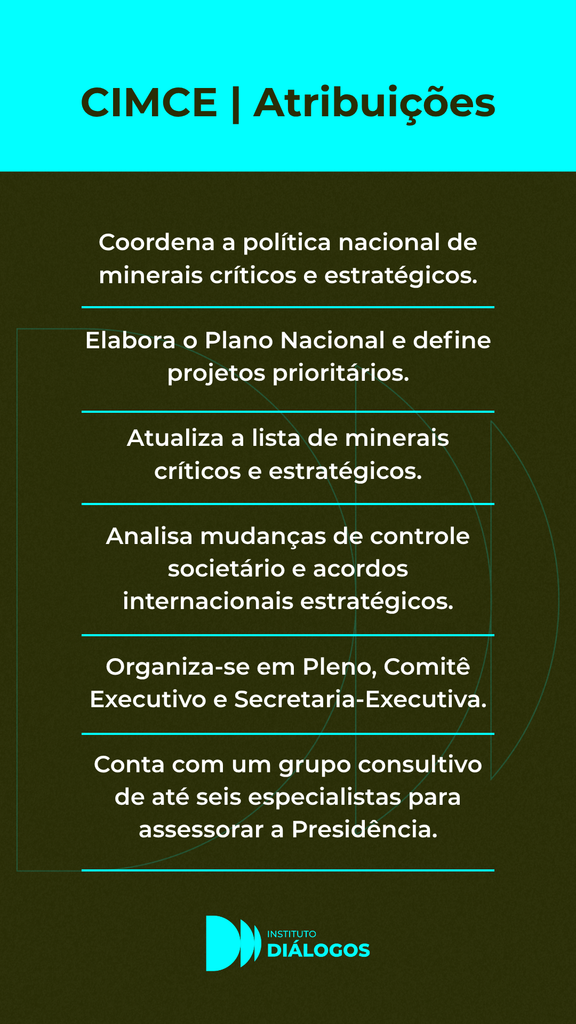
The CIMCE will be made up of the Plenary, the highest body for policymaking, strategic guidance, planning and the issuance of regulations; the Executive Committee, responsible for decisions on specific cases within the CIMCE’s remit; and the Executive Secretariat, responsible for administrative organization, for coordinating and preparing case files, and for providing technical and administrative support to the Plenary and the Executive Committee.
The same person may not serve on both the Plenary and the Executive Committee, including as an alternate. The Executive Secretary may not sit on the Plenary or the Executive Committee as an alternate member.
The Plenary consists of the following Ministers of State, with voting rights: the Chief of Staff of the Presidency (Casa Civil), who will chair it; the Head of the Institutional Security Office; and the Ministers of Agriculture and Livestock; Science, Technology and Innovation; Defense; Development, Industry, Trade and Services; Finance; Management and Innovation in Public Services; Environment and Climate Change; Mines and Energy; Planning and Budget; Foreign Affairs; and the Secretary-General of the Presidency.
The Plenary also includes, with voting rights, one representative of the states and the Federal District, one representative of the municipalities, two representatives of the private sector with recognized expertise in mineral policy, and one representative of higher education institutions with recognized expertise in the mining sector. Each member of the Plenary will have an alternate.
Regular meetings are scheduled every six months, and extraordinary meetings may be called by its President with at least five days’ notice. The quorum for Plenary meetings is an absolute majority, and decisions are approved by a simple majority. Decisions will take the form of resolutions.
The Executive Committee consists of one representative, with voting rights, from each of the following: the Ministry of Development, Industry, Trade and Services, which will coordinate it; the Casa Civil of the Presidency; and the Ministries of Science, Technology and Innovation; Defense; Finance; Mines and Energy; and Foreign Affairs.
The Executive Secretariat will operate within the Ministry of Development, Industry, Trade and Services as the technical and administrative support structure for the CIMCE, responsible for organizing its activities and coordinating the preparation of matters submitted to the Plenary and the Executive Committee.
The decree also establishes the Advisory Group (GA), a consultative body intended to advise the President of the Republic directly on matters related to critical and strategic minerals, including by preparing analyses, studies and recommendations.
The GA’s statements and recommendations will be strictly advisory and non-binding. The Group will have up to six members, chosen from among experts of recognized experience or knowledge. The GA’s coordinator will be appointed from among its members by the Head of the President’s Personal Office.
The setting up of the Council opens a new phase for mineral policy. How its decisions can help develop Brazil’s production chains is one of the questions that will be debated at the event organized by Instituto Diálogos.
Event details
Seminar Critical Minerals: From the New Law to Industrial Transformation
When: October 8, 2026, 9 a.m. to 12:30 p.m.
Where: ION Building Auditorium, Asa Norte, Brasília (DF)
Organized by: Instituto Diálogos
Registration: https://forms.gle/yhb6hQWtgbd93f6s6
Seating is limited to the auditorium’s capacity.