
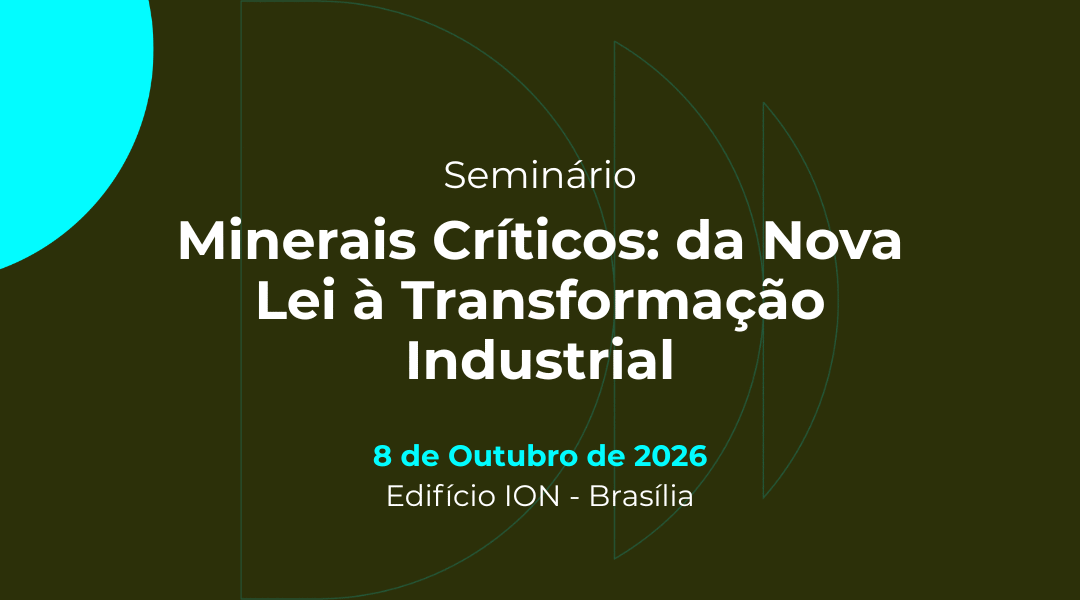
The lineup of the seminar “Critical Minerals: From the New Law to Industrial Transformation” brings together professionals whose careers span public policymaking, mining, institutional relations, technological development, the energy transition and mineral processing. The participants work at different points in the chain that will be discussed at the October 8 event in Brasília:
Tereza Cristina, leader of the Progressistas party (PP) in the Senate and senator for Mato Grosso do Sul, is a former Minister of Agriculture and chairs the Board of Directors of Instituto Diálogos. A motion she authored, approved in May 2026, led the Senate Foreign Relations and National Defense Committee (CRE) to debate the regulation of critical minerals and rare earths at a public hearing she chaired on June 2. In the final stretch of the legislative process for the sector’s new national policy, she submitted four amendments to Bill (PL) 2,780/2024. She withdrew one, and Amendments 1, 2 and 4, which concerned the wording, received a favorable opinion from the rapporteur, Senator Eduardo Braga, and were included in the Senate’s final text. The proposals dealt with the council created by the new law, the funding instruments and the definition of critical minerals.
Anderson Barreto Arruda is director of the Department of Mineral Processing and Technology and deputy to the National Secretary of Geology, Mining and Mineral Processing at the Ministry of Mines and Energy (MME). He holds degrees in Journalism and Law, is a career environmental analyst and previously headed the ministry’s Department of Mineral Planning and Policy. At the Casa Civil of the Presidency, he worked in the Investment Partnerships Program (PPI), supporting the environmental licensing of priority projects, and coordinated support for mining projects under the Pro-Strategic Minerals policy.
Pablo Cesário is director of Institutional Relations and Association Affairs and acting CEO of the Brazilian Mining Institute (IBRAM). He holds degrees in International Relations and Political Science and a PhD in International and Comparative Politics from the University of Brasília (UnB), and completed postdoctoral studies at the University of São Paulo (USP). He chaired the Brazilian Association of Publicly Held Companies (Abrasca) and worked at the National Confederation of Industry (CNI) with Congress and the Executive Branch. He represents IBRAM on the National Council for the Industrialization of Critical and Strategic Minerals (CIMCE).
Julio Cesar Nery Ferreira is director of Mining Affairs and Sustainability at IBRAM. A mining engineer who graduated from UFMG, he has more than 40 years of experience in environmental management, planning and operations in the mining sector.
Rafaela Guedes is a Senior Fellow at the Brazilian Center for International Relations (CEBRI), where she leads an energy transition program in partnership with multilateral development banks and the public and private sectors. An economist who graduated from the Federal University of Rio de Janeiro (UFRJ), she holds a master’s degree in international management from FGV. She worked at Petrobras for 17 years, where she served as chief economist and head of Corporate Social Responsibility. In May 2026, she took part in a public hearing of the Senate Infrastructure Committee on the future critical minerals policy.
Frederico Bedran Oliveira is executive director of the Critical Minerals Association (AMC) and a partner at the law firm Frederico Bedran Advogados. A geologist and lawyer, he holds a master’s degree in Economic Geology and Mineral Exploration and has more than 20 years of experience in the mining sector. He worked as a mineral resources specialist at the former National Department of Mineral Production (DNPM), now the National Mining Agency (ANM), and headed the MME’s Department of Geology and Mineral Production.
Caíque Souza is part of the team at Vallya, an independent consulting firm specializing in strategic advisory services. The company’s website lists him among its partners and analysts. At a public hearing held by the Federal Senate in 2026 to discuss the rare earths chain, he was introduced as an independent consultant with Vallya. His participation brings to the program professional experience in the economic and strategic analysis of projects and production chains.
André Luis Pimenta de Faria coordinates the SENAI Innovation and Technology Center for Rare Earth Magnets (CIT SENAI ITR) in Lagoa Santa (MG). The center is part of MagBras, an initiative that aims to build the entire production chain for these components in Brazil, using a neodymium-iron-boron (NdFeB) alloy, from mineral raw material to finished product. In February 2026, the unit received from the mining company Meteoric the first batch of rare earth carbonate obtained from material extracted in Brazil.
Marcos Berton is Technology and Innovation manager and chief researcher at the SENAI Institute for Innovation in Electrochemistry in Curitiba (PR), which he helped found in 2013. A chemist who graduated from the Federal University of Paraná (UFPR), he holds a master’s degree, a PhD and postdoctoral training from the Federal University of São Carlos (UFSCar). He spent 12 years as a senior researcher at Lactec, working on corrosion, battery and fuel cell projects for the electricity sector.
Marisa Cesar is director of Corporate Affairs and Sustainability at PLS Brasil and chair of the AMC Board. The company is part of the Australian group PLS, formerly Pilbara Minerals, a lithium producer that took over the Colina Project in Salinas (MG) in 2025 through its acquisition of Latin Resources. At the association, she advocates for the integration of companies working with energy transition minerals and for a stable regulatory environment. In June 2026, she represented the AMC at the CRE hearing on the regulation of the sector.
Rodrigo Toledo Cabral Cota is a civil servant on assignment to the Federal Senate and former director of the MME’s Department of Mineral Processing and Technology, a position he held from 2023 to July 2025. A career foreign trade analyst, he served as deputy executive secretary of the Ministry of Planning and Budget and headed the undersecretariats for Export Credit and Guarantees and for State-Owned Enterprise Governance in the federal government’s economic area. He has served on the boards of directors and fiscal councils of state-owned companies and financial institutions.
The seminar is sponsored by the Brazilian Mining Institute (IBRAM) and the Brazilian Confederation of Agriculture and Livestock (CNA).
EVENT DETAILS
Seminar “Critical Minerals: From the New Law to Industrial Transformation”
Date: October 8, 2026 Time: 9 a.m. to 12:30 p.m.
Venue: ION Building Auditorium, Asa Norte, Brasília, DF
View location on Google Maps
Program
9 a.m.
Institutional opening
Opening panel: Brazil’s new framework in international perspective
Panel 1: Rare earths: from projects to magnets and electric motors
Panel 2: From mine to value added
12:30 p.m.
Closing
Registration
https://forms.gle/yhb6hQWtgbd93f6s6
Registration is subject to the auditorium’s capacity.
Seating is limited and there will be no livestream.