
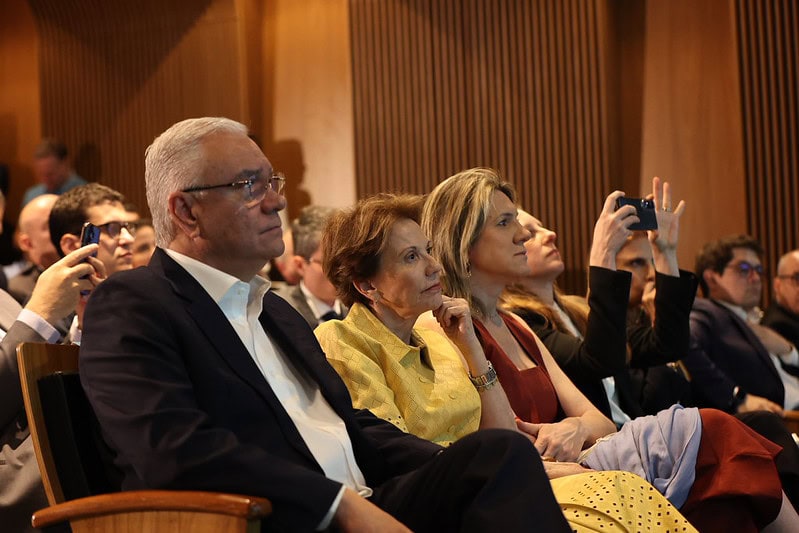
Instituto Diálogos’ first seminar on critical minerals discussed, in Brasília, paths to industrializing these minerals in Brazil.
Inconsistency and delays in regulating Law No. 15,506/2026, which established the national policy on critical and strategic minerals, could frustrate projections of placing Brazil among the leaders of the global market for these minerals, such as rare earths, lithium and copper, among others. The warning came from the Chair of the Board of Directors of Instituto Diálogos, Senator Tereza Cristina, at the opening of the seminar “Critical Minerals: From the New Law to Industrial Transformation” in Brasília.
In her view, the law is “a step forward, and its regulation process an opportunity to establish a modern and flexible legal framework.” Tereza Cristina believes that the industrial chain based on critical minerals “sees regulation as the foundation for integrating mineral policy and industrial policy,” with attention to instruments that favor investment, encourage research and technological development, and support Brazil’s international integration.
Organized by Instituto Diálogos on Thursday (October 8), the event discussed the opportunity to industrialize critical minerals in Brazil, bringing the public sector, business leaders and mining sector experts face to face. Tereza Cristina said the event will lead to further seminars on the same topic and that, in the end, “we aim to arrive at a mature interpretation, born of consensus on how to overcome the challenges and build consistent national projects.”
Experts discuss paths to industrialization
Panelists and moderators discussed how Brazil can build the capacity to industrialize critical minerals. They addressed the need for cooperation and trade agreements with other countries to develop technologies and industrial chains, but with a view to global competitiveness for producing companies. Countries and economic blocs are designing their own models for developing critical mineral industrial chains, and Brazil needs to establish its own, they said. Progress on rare earth projects, participants argued, depends on a combination of legal certainty, financing, technological development and an industrial policy capable of creating demand for the minerals produced in the country.
Frederico Bedran Oliveira, Executive Director of the Critical Minerals Association (AMC), highlighted the need to reconcile state control over projects deemed strategic with predictability for investors. According to him, Brazil has several projects under development and cannot create a review process that turns the new National Council for the Industrialization of Critical and Strategic Minerals, which reports to the Office of the President, into a bottleneck, since it could interfere with private-sector investment and business.
On the regulation of the national policy, he estimated that “putting the new rules into practice won’t happen in less than a year or a year and a half,” which he considers a long time, creating uncertainty for investors deciding whether to invest in Brazil. Both Bedran Oliveira and Pablo Cesário, Director of Institutional Relations and interim CEO of the Brazilian Mining Institute (IBRAM), said that regulation must take into account the particularities of each mineral chain. For Pablo Cesário, “talking about copper, lithium or rare earths is not the same thing. There are different businesses within this group, and we will need specific tools for each mineral.”
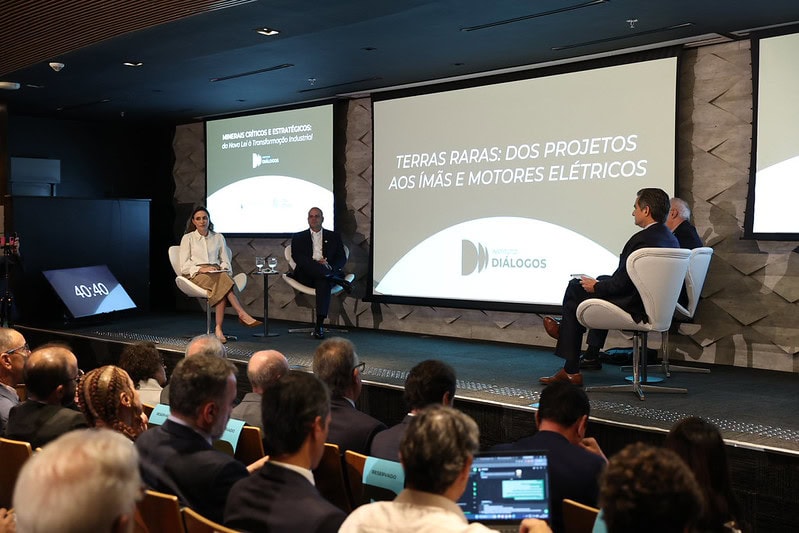
Aclara sees the possibility of separating rare earths in Brazil
Also calling for swift regulation, Aclara Resources Executive Vice President Jose Augusto Palma said his company could bring to Brazil a rare earth separation and refining technology that is still under development. This would make it possible to establish a more integrated production chain in Brazil. The initiative depends on the progress of mining projects and, later, on developing suppliers, training the workforce, technological development and connecting with the consumer market. “Developing the technology and the processes to create a supply chain and compete with that country [China] is a process that doesn’t happen overnight,” he said. Aclara, a Canadian company, plans to begin commercial production of rare earths in Goiás starting in 2028.
Marisa César, Director of Corporate Affairs and Sustainability at PLS Brasil and Chair of AMC’s Board of Directors, stressed that before talking about refining critical minerals in the country, it is necessary to achieve mineral production at scale. Without a minimum scale, there is no way to “justify having a midstream plant, because the numbers don’t add up.” Midstream is the stage of the chain that turns extracted minerals into processed, refined or separated materials ready to supply end-product manufacturers.
Federal government sees critical minerals as strategic assets
The federal government was represented by Anderson Barreto Arruda, Acting National Secretary of Geology, Mining and Mineral Transformation at the Ministry of Mines and Energy. Addressing business leaders working with critical minerals, Arruda said the government intends to “look at each project and see which ones are strategic, not only for the shareholder but for the country, and get these projects off the ground as quickly as possible.”
Arruda explained that the federal government’s interest is, in some way, to take a strategic view of mining assets. “Today there is no commercial intelligence in the sector. The government, the Brazilian State, does not know about or hold information on commercial transactions (involving minerals). The government simply learns about the mining sector’s commercial transactions from the press. And we often even miss the opportunity to steer investment toward a particular chain that we would like to develop,” he said.
In response to Arruda, Frederico Bedran, of AMC, said the Brazilian State deserves to know about all transactions, and that this can be done by organizing a baseline registry of mining projects.
For Marcos Berton, Technology and Innovation Manager and chief researcher at the SENAI Institute for Innovation in Electrochemistry, Brazil’s challenge is to turn knowledge and mineral resources into an industry capable of competing in specific markets. He praised the program of the seminar organized by Instituto Diálogos: “for the first time, we are talking about industrial transformation: about how we move beyond this extremely important role in mineral production and turn this movement into an industry.” Berton highlighted initiatives to develop a lithium-ion battery production chain in Brazil, but called for greater coordination of efforts. “We lack national coordination to lead this, to give it direction. We need focus,” he said.
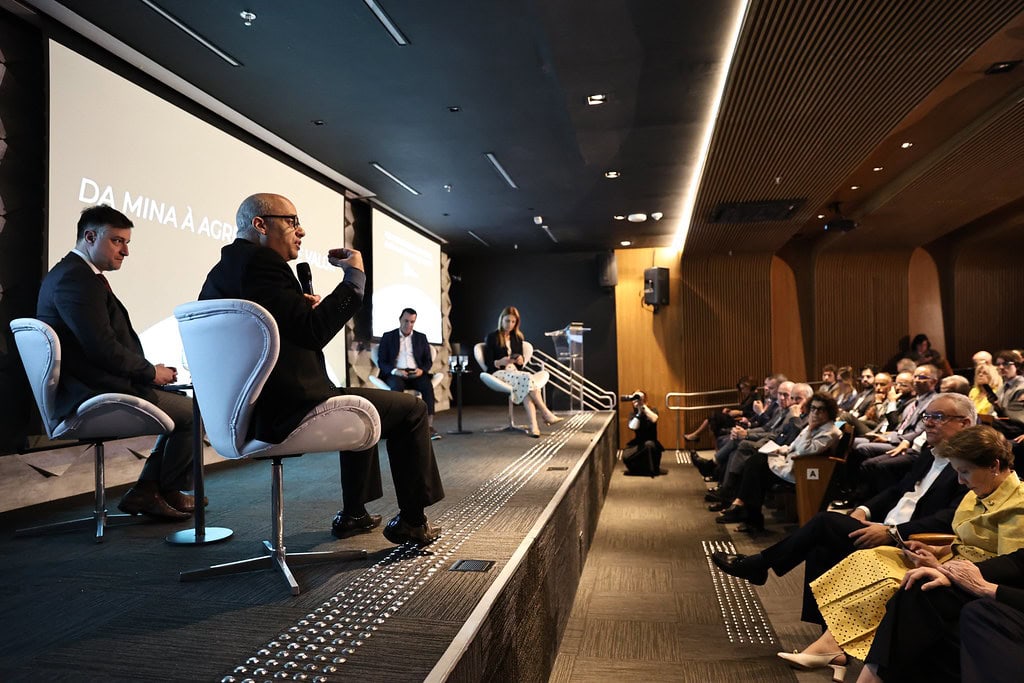
Brazil needs to turn its resources into industrial and technological capacity
At the end of the debates, there was consensus that Brazil has a strategic opportunity to expand its share of global critical mineral chains, but needs to turn its resources into industrial and technological capacity. This requires long-term investment in research, innovation and infrastructure, as well as greater coordination among government, companies and research centers, and partnerships with countries that already master specific technologies. The creation of mineral processing hubs was also pointed out as a way to bring together companies and technology, increase value added and accelerate the development of these chains in the country.
Also taking part in the seminar were Rafaela Guedes, economist and Senior Fellow at the Brazilian Center for International Relations (CEBRI); Larissa Wachholz, partner at the consulting firm Vallya and Senior Fellow at CEBRI; Caíque Souza, consultant at Vallya; Julio Nery, Director of Mining Affairs and Sustainability at IBRAM; Rodrigo Toledo Cabral Cota, a Federal Senate civil servant specializing in the mining sector; Fernando Camargo, President of the Executive Board of Instituto Diálogos; and Inácio Muzzi, Director of the Institute. The audience, which filled the auditorium, included public figures and officials such as federal deputy Arnaldo Jardim, rapporteur of Bill No. 2,780/2024, which gave rise to the public policy on critical minerals; former Minister of Mines and Energy Bento Albuquerque; and former minister Izabella Teixeira, among others.
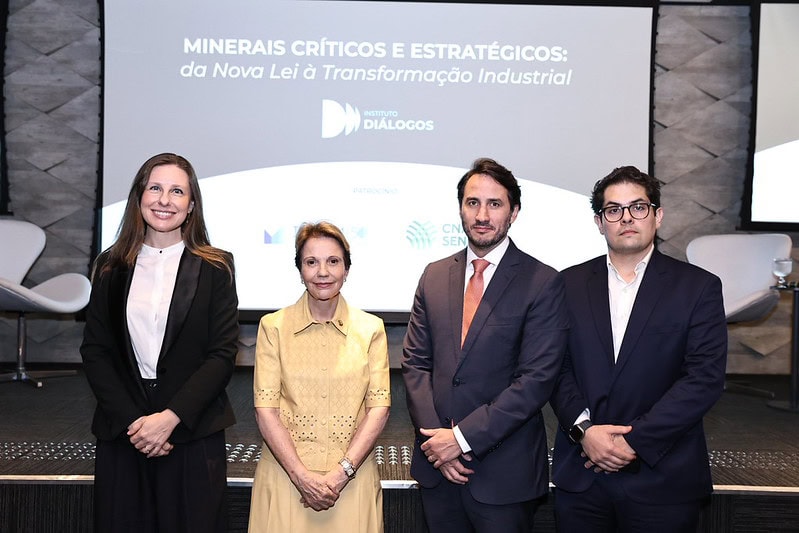
The seminar was sponsored by the Brazilian Mining Institute (IBRAM) and the Brazilian Confederation of Agriculture and Livestock (CNA), through the Senar CNA System.
Press contact:
Profissionais do Texto
WhatsApp: +55 61 98163-0666 – Sergio Cross