
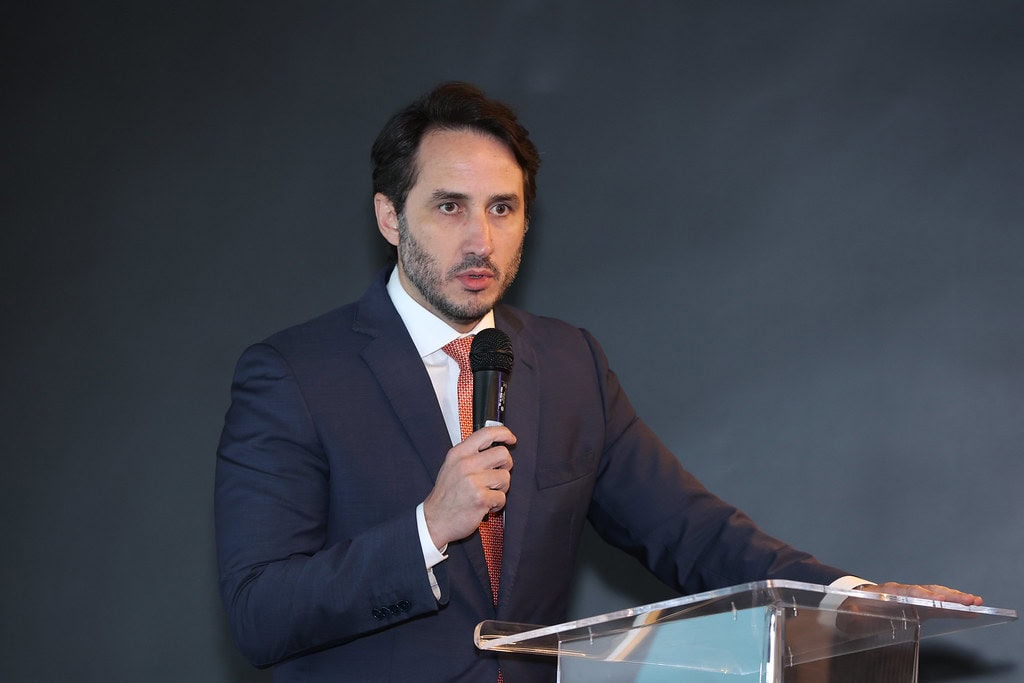
At an Instituto Diálogos seminar, Anderson Arruda explains how Brazil can take part in international industrial chains, but does not present the government’s criteria for identifying the projects considered strategic under the National Policy on Critical and Strategic Minerals.
Brazil can expand its share of international magnet and battery chains by supplying minerals and through long-term trade agreements, without necessarily manufacturing these products in the country. That is the assessment of Anderson Arruda, Acting National Secretary of Geology, Mining and Mineral Transformation at the Ministry of Mines and Energy (MME). “We have been hearing a lot about magnet and battery chains. I personally believe Brazil can be a leader in these chains. I’m not even talking about producing batteries or producing magnets, but Brazil can be integrated into these global chains that demand minerals, supply and long-term trade agreements,” he said.
The statement presents a possibility for Brazilian participation in international industrial chains, a topic of interest to companies and investors in the mining sector. On the regulatory instruments of the new policy, however, Arruda acknowledged business leaders’ caution and did not detail the criteria the government intends to use to identify the projects considered strategic for the country.
Government acknowledges lack of information on the sector’s transactions
During the opening panel “Brazil’s new framework in international perspective,” at the seminar “Critical Minerals: From the New Law to Industrial Transformation,” held by Instituto Diálogos on October 8 in Brasília, Arruda acknowledged that the federal government does not have sufficient information on the mining sector’s commercial transactions, which it learns about from the press.
“Today there is no commercial intelligence in the sector. The government, the Brazilian State, does not know about or hold information on commercial transactions,” he said. According to him, the lack of information on these transactions can cause the government to miss opportunities to steer investment toward production chains of national interest.
Criteria for strategic projects remain unclear
Arruda said he had noticed “a certain caution, a certain fear” among mining companies regarding the new regulatory instruments. Explaining the government’s proposal, he said: “Much more than granting tax credits to companies across the board, our proposal is for the government to be able to look at each project and see which ones are strategic, not only for the shareholder but for the country, and get these projects off the ground as quickly as possible.”
The secretary, however, did not detail which criteria will be used to identify the projects considered strategic for the country or how this assessment will be carried out under the National Policy on Critical and Strategic Minerals, established by Law No. 15,506/2026.
Guarantee fund and incentives to make projects viable
Addressing the mechanisms provided for in the new legislation, Arruda highlighted the guarantee fund and tax credits as instruments that could help make mining projects viable and speed up their implementation.
“The instruments brought by the new critical minerals policy law, especially the guarantee fund and some tax credits, will allow us to unlock projects that until now were not viable,” he said.
Research and innovation to develop new capabilities
The secretary also called for a recovery of investment in mining-related research, development and innovation. According to him, critical mineral projects offer opportunities to attract this investment and develop industrial activities that do not yet exist in Brazil.
Arruda also highlighted the need for public policies that prepare Brazilian universities to meet the mining sector’s new demands. In his view, public policies aimed at the sector’s future should consider horizons of ten or twenty years.
The seminar was sponsored by the Brazilian Mining Institute (IBRAM) and the Brazilian Confederation of Agriculture and Livestock (CNA), through the Senar CNA System. Vallya Consulting and the Brazilian Center for International Relations (CEBRI) supported the organization of the seminar program.