
Rare earths can be strategic minerals, but not every strategic mineral is a rare earth.
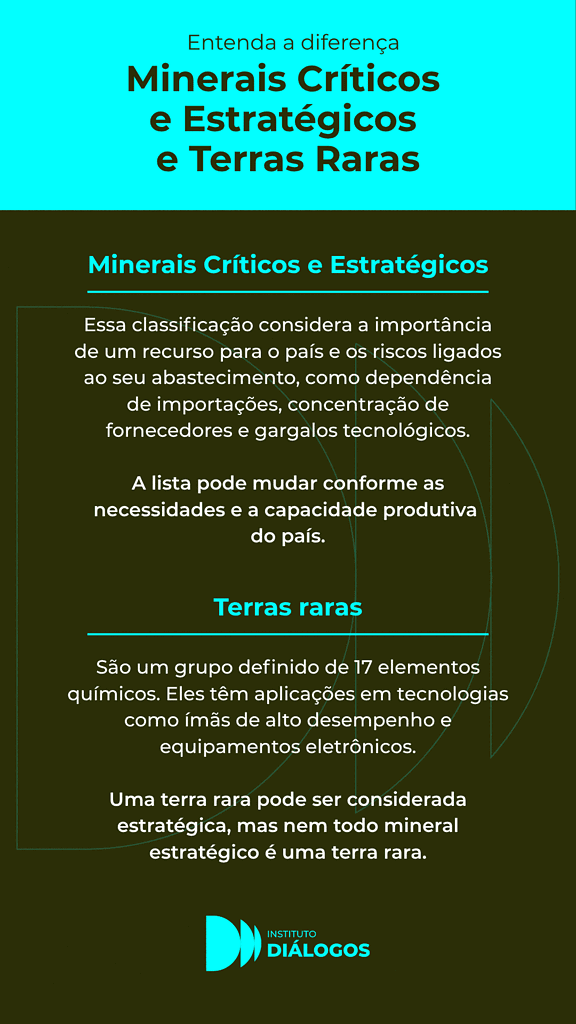
Critical and Strategic Minerals
- Law No. 15,506 of September 16, 2026, which establishes the National Policy on Critical and Strategic Minerals (PNMCE) and creates the National Council for the Industrialization of Critical and Strategic Minerals (CIMCE), defines critical and strategic minerals as resources needed by key sectors of the national economy whose availability is insufficient, unstable or vulnerable because of a shortfall in domestic production.
- High dependence on imports, the geographic concentration of foreign supply, geopolitical risks, market restrictions or technological bottlenecks — and the possibility that their scarcity poses a significant risk to the country’s economy — also make them strategic.
- Critical and strategic minerals have acquired geopolitical status because they are essential to the economy, defense, technological and industrial development, the energy transition and food security — and thus to countries’ independence.
- They can vary from country to country and become strategic when the vulnerability of stocks or deposits brings entire production chains to a halt and compromises national security.
- They are an economic and geopolitical classification, with a dynamic list that can change according to each country’s stage of technological development. Law No. 15,506 provides that it is up to the CIMCE (Art. 41) to define and update the substances that qualify as critical minerals and strategic minerals.
Rare Earths (Rare Earth Elements – REE)
- They are 17 chemical elements of the periodic table: the 15 lanthanides plus scandium and yttrium. Rare earths may not actually be rare; what makes them “rare” is how difficult it is to find them in concentrations that are economically viable to exploit.
- According to the Ministry of Mines and Energy, Brazil has the world’s second-largest REE reserves, at 21 million metric tons. The world leader is China, with 44 million, which is considered the country with the greatest mastery of extraction and processing.
- The National Mining Agency (ANM) notes that having reserves does not mean mastering the production chain. That is Brazil’s challenge, which the PNMCE and the CIMCE will seek to address: expanding investment, adding value to domestic production and reducing external dependence on strategic raw materials.
Understanding these distinctions helps gauge the scale of Brazil’s challenge: turning mineral resources into knowledge, technology and higher-value products. The topic will be at the center of the seminar organized by Instituto Diálogos.
Seminar Critical Minerals: From the New Law to Industrial Transformation
When: October 8, 2026, 9 a.m. to 12:30 p.m.
Where: ION Building Auditorium, Asa Norte, Brasília (DF)
Organized by: Instituto Diálogos
Registration: https://forms.gle/yhb6hQWtgbd93f6s6
Seating is limited to the auditorium’s capacity.