
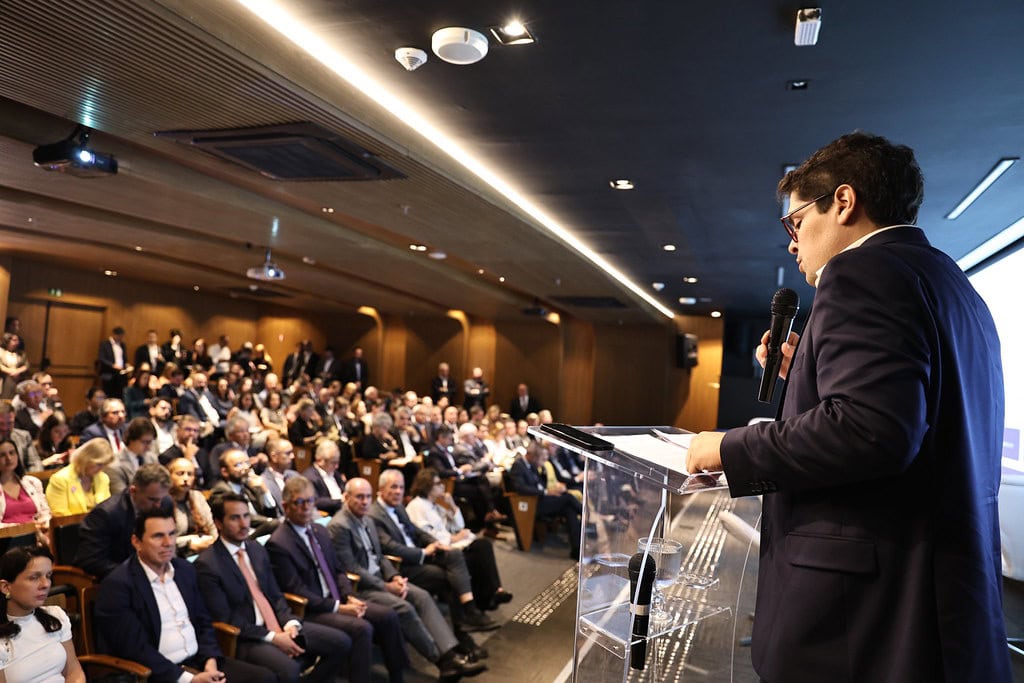
At an Instituto Diálogos seminar, Vallya Consulting warns of the consequences of postponed choices and calls for transparency in government decisions, as well as an industrial policy to add value to Brazilian mineral production.
The implementation of the National Policy on Critical and Strategic Minerals puts Brazil before decisions that could shape the development of its production chains for decades to come. That is the assessment of Caíque Souza, a consultant at Vallya, who highlights the need for an industrial policy capable of attracting investment to mineral transformation and calls for transparency in government decisions on the sector’s projects.
During the seminar “Critical Minerals: From the New Law to Industrial Transformation,” held by Instituto Diálogos on October 8 in Brasília, Caíque said that the approval of Law No. 15,506/2026 is a step forward, but that its results will depend on the choices made from now on. The law is being regulated by the Executive Branch. According to him, the diagnosis that Brazilian mineral production needs to be industrialized has been shared for years by the government, companies and civil society. This convergence was also reflected in the approval of the new legislation by Congress.
Looking to the past to chart the future
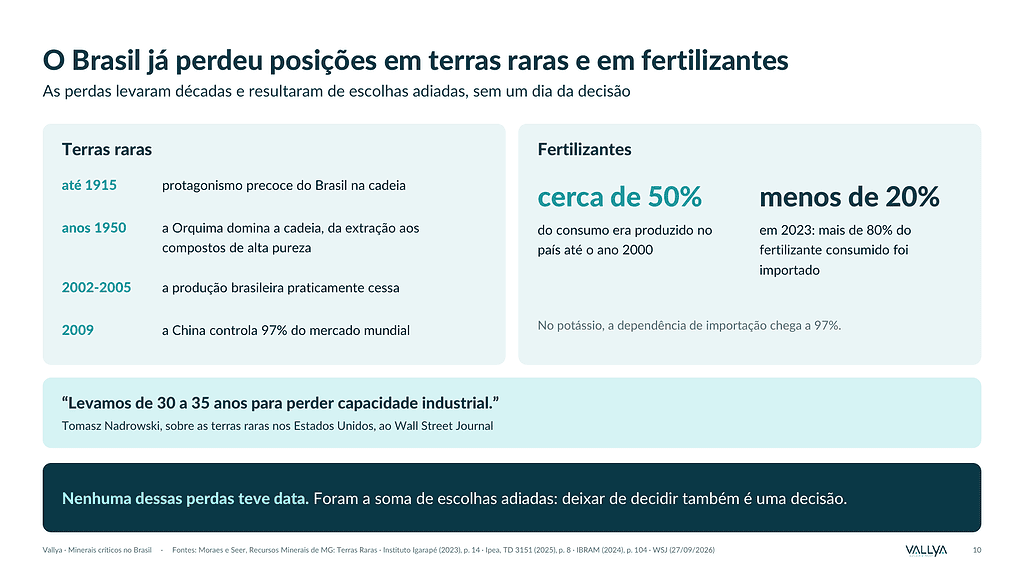
To show the consequences of postponed strategic decisions, Caíque revisited Brazil’s history in the rare earth and fertilizer sectors. In the 1950s, Brazil had industrial capacity ranging from rare earth extraction to the production of high-purity compounds. Between 2002 and 2005, however, domestic production practically ceased. In fertilizers, the country produced about half of what it consumed until 2000, but came to depend on imports for more than 80% of consumption in 2023.
The consultant attributed these losses to an accumulation of postponed or inadequate choices over time. “Failing to decide, therefore, is also a decision, and it too will last for decades,” he said.
Mineral reserves and industrial transformation
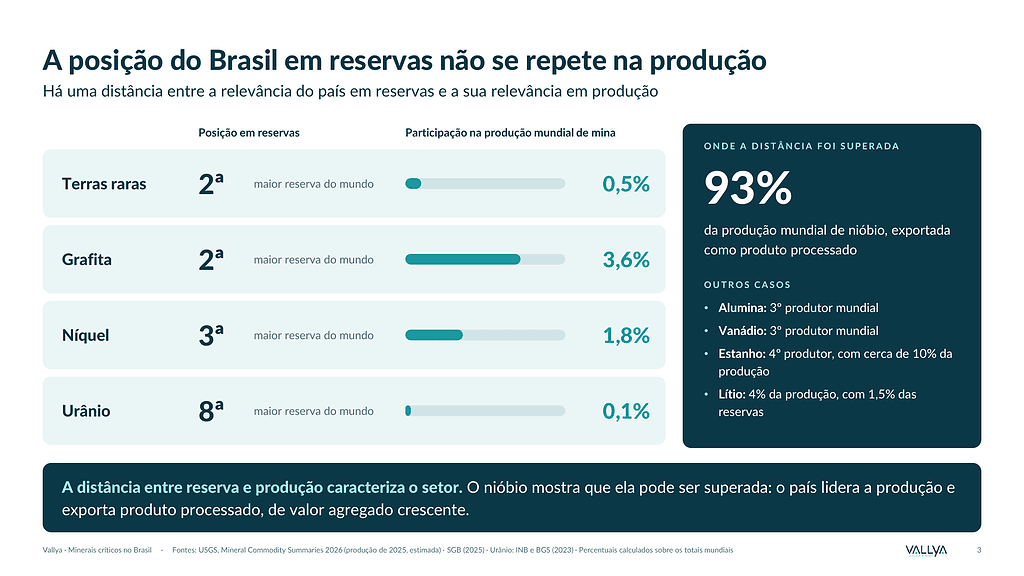
Caíque presented data showing the gap between Brazil’s geological potential and the country’s share of world critical mineral production. Brazil has the world’s second-largest rare earth reserves, but accounted for only 0.5% of world mine production in 2025. In graphite, it also ranks second in reserves, with a 3.6% share of production. In nickel, it holds the third-largest reserves, but accounts for 1.8% of world production.
The consultant cited niobium as an example of industrial use of mineral resources. Brazil accounts for about 93% of world production and exports processed products. In other segments, transformation takes place mostly outside the country. He noted that Brazil exported 1.45 million tons of copper concentrate in 2025, while importing 254,000 tons of refined copper. In rare earths, the carbonate produced in the country is separated abroad.
Industrial transformation should not be an obligation of mining companies
For the Vallya consultant, industrial progress requires recognizing that mining and transformation are activities with different economic characteristics. Whoever develops a mine from exploration onward takes on geological, licensing and price risks over periods that can exceed a decade, which requires a higher return on invested capital. Industrial projects, in turn, have a different risk profile and may rely on pre-contracted demand.
Caíque stressed that industrial transformation should not be an obligation of mining companies. According to him, it is up to industrial policy to create the conditions for developing the stages after extraction, with the support and participation of mining companies from the project planning stage.
The consultant’s proposal is to use Brazil’s mineral advantages to attract new industrial and technological investment, with policies capable of maintaining their instruments and objectives over the years.
International experience and investment in Brazil
Caíque argued that the Brazilian State should play a role beyond that of regulator, with financing instruments and incentives capable of stimulating the industrial development of mineral chains. To support this position, he presented experiences from the European Union, Canada, Australia, Japan, India and Indonesia, which use mechanisms such as public financing, tax incentives, industrial targets and the selection of strategic projects.
He also compared the Chinese strategy, built over decades with strong state direction, with the model prevailing in the West, based on company specialization and on assessing the risks of each project stage. According to the consultant, international experiences are still evolving, but share a common element: the role of governments in forming and strengthening production chains.
Regarding China and the United States, Caíque argued that Brazil should set its own industrial objectives, regardless of where its trading partners come from. He reported that China received 99.7% of the rare earth compounds exported by Brazil in 2025. Between January and September 2026, however, shipments of these products went to Estonia, Canada and the United States, with no exports to the Chinese market.
Addressing the presence of international interests in the Brazilian mining sector, the consultant summed up the position he considers necessary for the country. “We want to densify the chains here, generate technology here, generate jobs here.”
New law creates instruments to finance industrialization
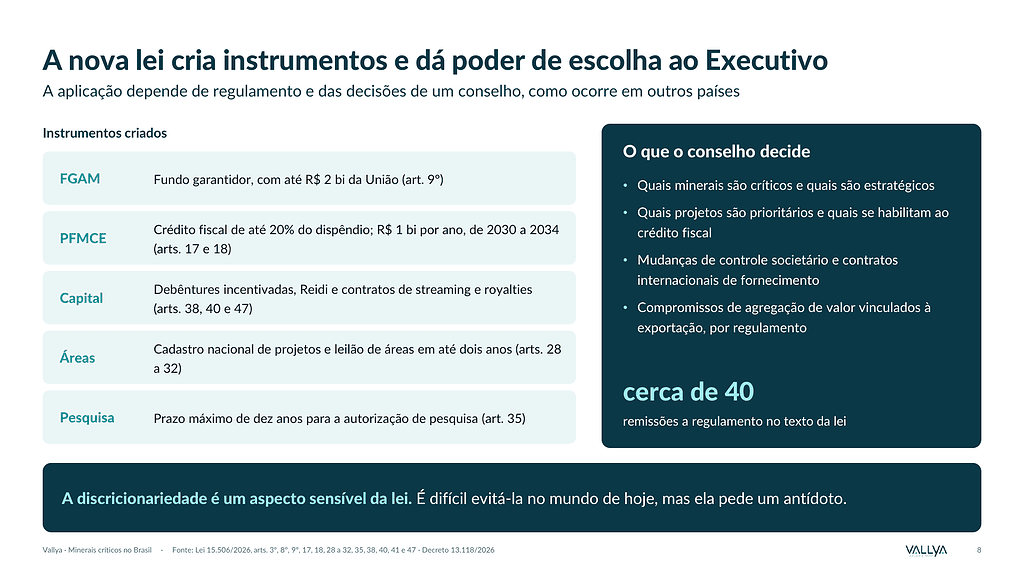
Law No. 15,506/2026 established mechanisms to support the development of critical and strategic mineral chains. Among them, Caíque highlighted the Mining Activity Guarantee Fund (FGAM), with a possible federal contribution of up to R$ 2 billion, and the tax credit ceiling of R$ 1 billion per year, between 2030 and 2034, for beneficiation and transformation activities.
The legislation also provides for incentivized debentures and other instruments to stimulate investment. Its implementation involves decisions on which minerals and projects will receive priority, as well as the review of certain corporate transactions and international contracts.
Transparency should guide the council’s decisions
According to the consultant, the breadth of the powers of the National Council for the Industrialization of Critical and Strategic Minerals (CIMCE) calls for special attention to the criteria adopted by the government. Caíque acknowledged that state participation in strategic decisions is part of the mineral policies of several countries, but warned of the risks associated with exercising discretionary powers without due transparency.
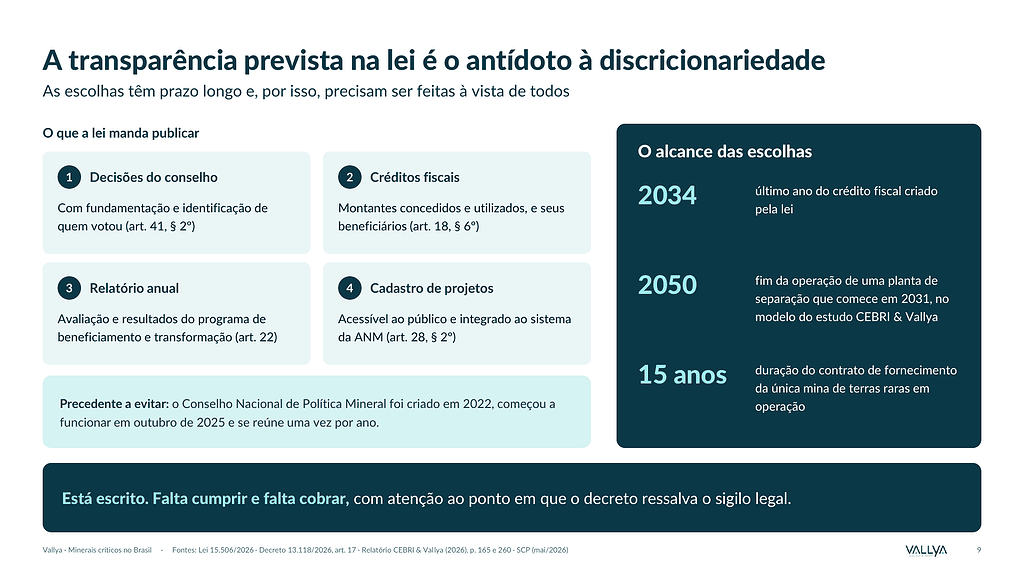
Caíque noted that the legislation itself establishes publicity and accountability mechanisms. These include the disclosure of the council’s reasoned decisions, identifying those who took part in the votes, the amounts and beneficiaries of the tax credits granted, and the results of the beneficiation and mineral transformation policy.
“But discretion calls for an antidote. And that antidote is transparency,” he said.
The consultant drew particular attention to the legal confidentiality exception provided for in the regulations and called for monitoring its application. He also pointed to the need to avoid delays in implementing the measures, citing as a precedent the National Mineral Policy Council, created in 2022, which only began operating in October 2025.
Rare earth oxide separation plant could take 5 years to start operating
To gauge the reach of current decisions, Caíque presented an estimate from a study he took part in, according to which a rare earth oxide separation plant with an investment decision taken in 2026 would not start operating before 2031. According to his presentation, this timeline shows the importance of consistent policies capable of spanning different governments and economic cycles.
Closing his presentation, the consultant drew a parallel with the decisions taken by Brazil in the 1940s, which contributed to building the country’s steel, mining and logistics infrastructure. In Caíque’s assessment, the current critical minerals policy is an opportunity to make choices with equally lasting effects on Brazil’s industrial development.
The seminar was sponsored by the Brazilian Mining Institute (IBRAM) and the Brazilian Confederation of Agriculture and Livestock (CNA), through the Senar CNA System. Vallya Consulting and the Brazilian Center for International Relations (CEBRI) supported the organization of the seminar program.